When Executive Narrative Overrides Product Signalling (Analysis of X Activity)
This analysis compares the content posted by Jason Kwon (@jasonkwon), CSO of OpenAI, and the official OpenAI account (@OpenAI) over a two-week period (January 7 to January 21, 2026). The objective is to quantify the focus on the ongoing legal conflict with Elon Musk versus announcements of significant product updates and improvements.
Summary of Activity Focus
The data reveals a distinct difference in content strategy between the individual executive and the corporate account, particularly in their engagement with the Musk lawsuit.
| Account | Total Relevant Posts | Musk-Related / Lawsuit Defence | Product Updates / News | Ratio (Musk : Product) |
|---|---|---|---|---|
| Jason Kwon (@jasonkwon) | 21 | 15 (71.4%) | 6 (28.6%) | 2.5 : 1 |
| OpenAI Official (@OpenAI) | 8 | 2 (25.0%) | 6 (75.0%) | 1 : 3 |
Screenshots and referencesAnalysis of Jason Kwon's Activity
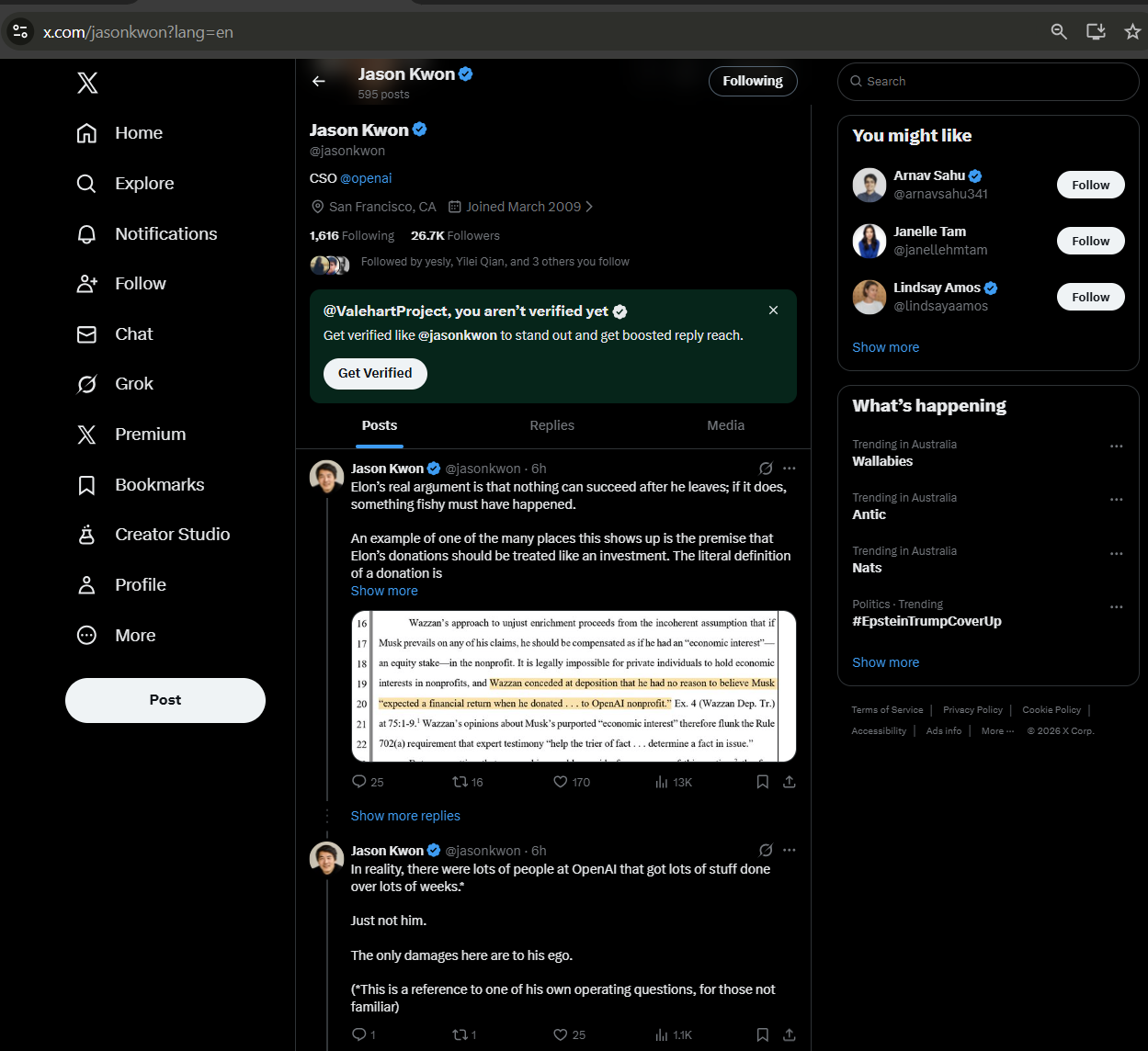
Jason Kwon's X profile was primarily utilized as a platform for direct, personalised engagement against Elon Musk, with 71.4% of his relevant activity dedicated to the topic. This content directly addressed the Musk v. Altman lawsuit and related public relations narratives [1].
Musk-Related / Lawsuit Defence (15 Posts/Reposts)
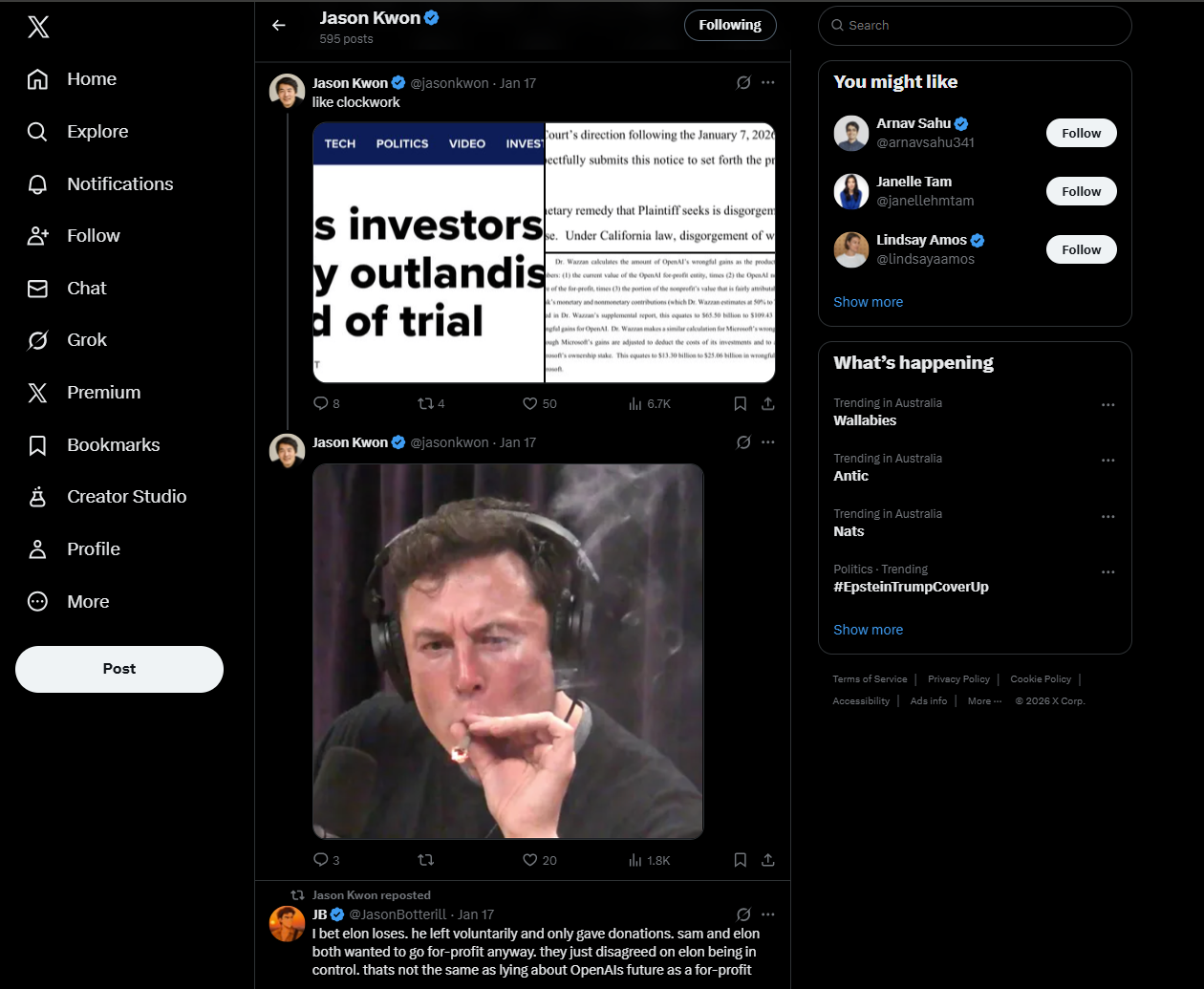
The posts were concentrated around January 17–21, coinciding with the public release of court filings and counterstatements from OpenAI. Key themes included:
Challenging Motives: Directly questioning Musk's argument that nothing could succeed at OpenAI after his departure and criticizing the premise that his initial contributions should be treated as an investment [1].
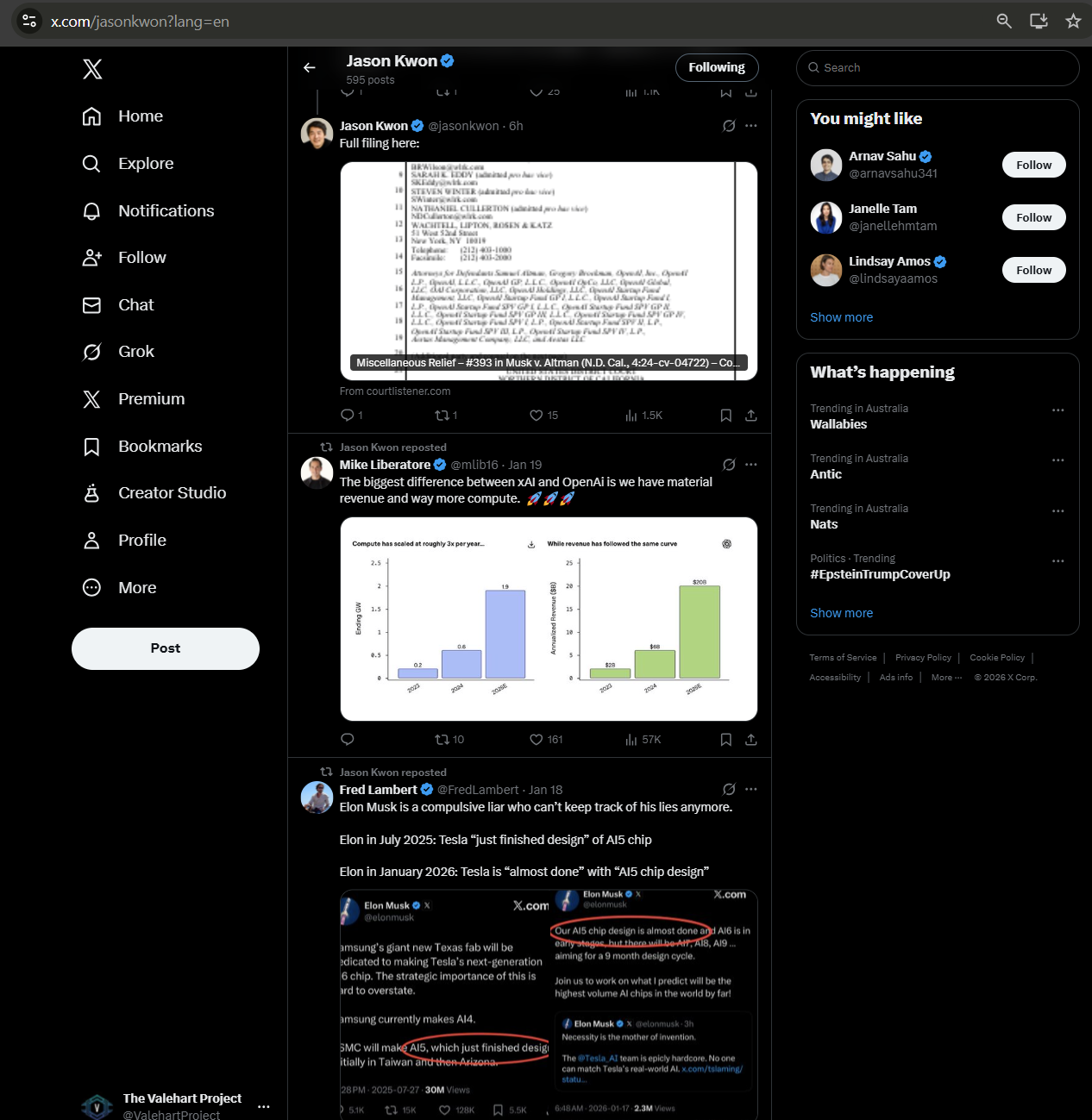
Defence of Leadership: Reposting statements from Sam Altman and Greg Brockman, including the official "The truth Elon left out" blog post [2], and supporting other employees who defended Brockman against claims of "cherry-picking" [1].
Public Relations Counter-Narrative: Sharing links to the full court filing [3] and reposting content that characterized Musk as a "compulsive liar" regarding his own company's (Tesla's) AI chip development timeline [1].
Actual News About OpenAI (6 Posts/Reposts)
The minority of his posts focused on company progress, largely reposting content from other OpenAI executives or external sources. These posts highlighted:
Growth Metrics: Reposting news of all-time high user metrics and surging demand, as reported in an investor letter [4].
Technical Achievements: Highlighting the use of GPT 5.2 to solve a complex mathematical problem (the "third Erdos problem") [1].
Strategic Hires and Product Focus: Announcing the return of key researchers [1] and the launch of ChatGPT Health [5].
Analysis of OpenAI Official Activity
In contrast, the official @OpenAI account maintained a product-centric focus, with 75% of its relevant posts announcing significant updates and improvements. The account's engagement with the Musk conflict was limited to two high-profile reposts on January 17, serving as a unified corporate response without becoming the primary content stream.
Significant Updates and Improvements (6 Announcements)
The official announcements demonstrate a clear focus on product expansion, monetization, and safety:
| Date | Announcement / Improvement | Category | Reference |
|---|---|---|---|
| Jan 21 | Rolling out age prediction on ChatGPT for enhanced teen safeguards. | Safety / Product | [6] |
| Jan 17 | Global rollout of ChatGPT Go, a low-cost subscription tier with expanded features (10× messages, file uploads, unlimited GPT 5.2 instant). | Monetization / Product | [7] |
| Jan 17 | Announcement of testing ads in ChatGPT Free and Go tiers, including publication of advertising principles. | Monetization / Strategy | [8] |
| Jan 16 | Improved memory in ChatGPT, increasing reliability when recalling details from prior conversations. | Product Improvement | [9] |
| Jan 13 | Acquisition of Torch, a healthcare startup, to integrate lab results and medication data into ChatGPT Health. | Strategic / Product | [10] |
| Jan 8 | Introduction of ChatGPT Health, a dedicated and secure space for health-related conversations. | New Product | [11] |
Musk-Related / Lawsuit Defence (2 Reposts)
The two Musk-related posts were direct reposts of Greg Brockman and Sam Altman's statements on January 17, serving to amplify the executive response to the lawsuit without generating new, original content on the topic [1].
Conclusion
The comparative analysis indicates a dual-track communications strategy at OpenAI during this period. The official corporate channel prioritized the announcement of six significant product and strategic updates (e.g., ChatGPT Health, ChatGPT Go, ad testing), maintaining a focus on growth and accessibility. Conversely, the executive account of Jason Kwon was heavily leveraged for direct, high-context engagement with the Elon Musk lawsuit, dedicating over two-thirds of its activity to defending the company and its leadership.
This pattern is consistent with a dual-track communications approach to insulate the official brand from the direct conflict while using an executive's personal channel to high-frequency public response the public relations aspect of the lawsuit.
References
[1] Jason Kwon (@jasonkwon) X Profile (Jan 7 – Jan 21, 2026).
[2] The truth Elon left out – OpenAI Blog.
[3] Miscellaneous Relief – #393 in Musk v. Altman (N.D. Cal., 4:24-cv-04722) – CourtListener.com.
[4] OpenAI Investor Letter: Weekly and daily active user figures 'continue to produce all-time highs' – CNBC.
[5] Introducing ChatGPT Health – OpenAI Blog.
[6] Our approach to age prediction – OpenAI Blog.
[7] Introducing ChatGPT Go, now available worldwide – OpenAI Blog.
[8] Our approach to advertising and expanding access to ChatGPT – OpenAI Blog.
[9] samir (@_samirism) X Post on ChatGPT memory improvements (Jan 16, 2026).
[10] OpenAI acquires Torch – OpenAI Blog.
[11] Introducing ChatGPT Health – OpenAI Blog.